

Markers can make an adult coloring page look rich and smooth, but they can also ruin the page behind it in seconds. It’s easy to find a set with lots of colors. But how to select a marker that suits your paper, your coloring style, and the amount of ink you tend to use?
Alcohol markers are usually the best choice for smooth blends and strong flat color. They also have the highest bleed-through risk. Water-based markers are safer for thin and double-sided books, but they need a lighter hand and can leave streaks if you work too slowly.
This guide compares seven of the best markers for adult coloring books, from affordable Ohuhu sets to refillable Copic Sketch markers. You will also learn which tip works best for detailed mandalas, how to protect the next page, and why no marker should be called bleed-proof without testing it on your actual book.
Quick Picks
- Best overall alcohol marker: Ohuhu Honolulu
- Best for thin or double-sided pages: Tombow Dual Brush Pens
- Best premium refillable marker: Copic Sketch
- Best for fine details: Prismacolor Premier Art Markers
- Best for a firm fine and chisel combination: Arteza EverBlend
- Best budget alcohol marker set: Bianyo Classic Series
- Best budget water-based set: Ohuhu Maui
For most adult colorists, Ohuhu Honolulu gives the best balance of color range, brush control, blending, and price. Choose Tombow Dual Brush Pens if protecting the reverse side matters more than getting very smooth alcohol-marker blends. Pick Copic Sketch if you color often and want a marker system with matching refills and replaceable nibs.
Table of Contents
At-a-Glance Comparison: Specs and Best Uses
The bleed-risk column assumes thin, uncoated coloring book paper. A different paper finish, extra pressure, or another layer of ink can change the result. Test every marker on a spare page before using it in a book you care about.
| Marker | Ink Type | Tip Options | Color Range |
|---|---|---|---|
| Ohuhu Honolulu | Alcohol-based dye ink | Brush and chisel, or brush and fine | Sets up to 320 colors plus a blender |
| Tombow Dual Brush Pens | Water-based ink | Brush and fine | 108 options including a colorless blender |
| Copic Sketch | Alcohol-based dye ink | Super Brush and Medium Broad | 358 colors |
| Prismacolor Premier Dual-Ended | Alcohol-based dye ink | Fine and chisel, with some fine and brush kits | Palette of 200 colors |
| Arteza EverBlend | Alcohol-based ink | Fine and chisel | Sets up to 120 colors |
| Bianyo Classic Series | Alcohol-based ink | Broad and fine | Large sets, including 72 and 180 |
| Ohuhu Maui | Water-based ink | Brush and 0.4 mm fine | Sets up to 160 colors |
Paper fit and refill support
| Marker | Bleed Risk on Thin Paper | Refill or Replacement Support | Best Use |
|---|---|---|---|
| Ohuhu Honolulu | High | Refill ink for selected colors and replacement brush nibs | Blending, backgrounds, general coloring |
| Tombow Dual Brush Pens | Lower, but not impossible | Sold individually, not ink-refillable | Thin paper, double-sided books, soft washes |
| Copic Sketch | High | Refillable in all colors, replaceable nibs | Frequent use, controlled blends, long-term marker system |
| Prismacolor Premier Dual-Ended | High | Not ink-refillable | Small details, firm lines, flat color |
| Arteza EverBlend | High | Replaceable nibs, not ink-refillable | Firm tip control, blocks of color, shading |
| Bianyo Classic Series | High | Some individual replacement colors, no ink refill system | Low-cost practice, broad fills, simple detail work |
| Ohuhu Maui | Lower, but heavy layering can still show through | Not ink-refillable | Beginners, thin pages, lettering, small details |
Quick takeaway: Buy for your paper first. Alcohol markers can give the smoothest result, but they should be treated as bleed-through markers on normal coloring book paper. Water-based markers lower that risk, though repeated wet passes can still soak, buckle, or roughen a thin page.
Alcohol vs. Water-Based Markers
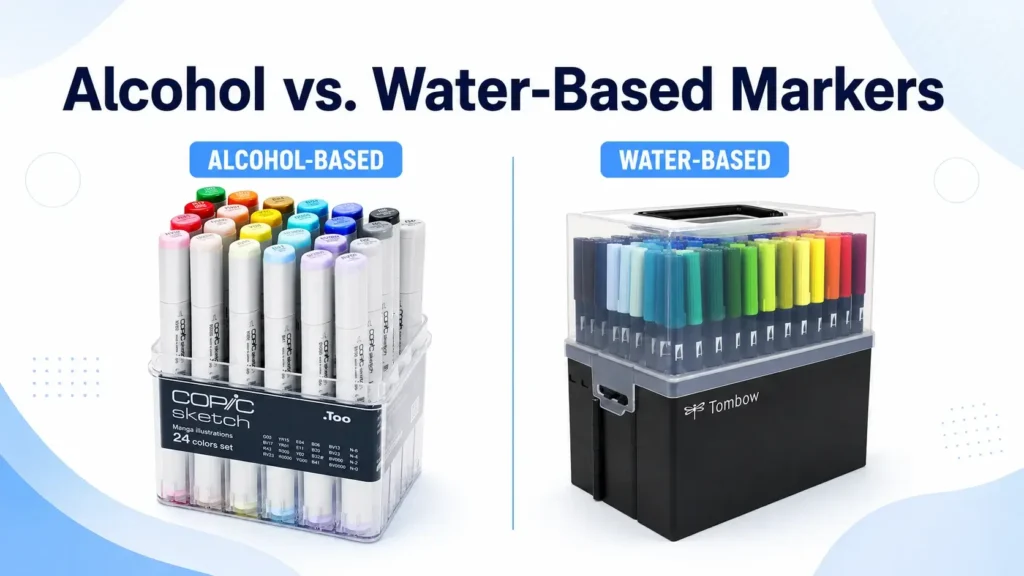
The ink formula affects nearly every part of the coloring experience. It changes how quickly the marker dries, how it blends, how much it smells, and how likely it is to reach the back of the sheet.
Alcohol-Based Markers
Alcohol markers use dye carried in an alcohol-based solvent. The ink dries quickly and layers well. When two shades are applied while the paper is still wet, their edges can soften into a smooth transition. This makes alcohol markers useful for skin, flowers, shadows, large backgrounds, and any area where visible stroke lines would be distracting.
That same fluid ink moves deep into paper fibers. On standard coloring book paper, bleed-through is normal. A thicker page may slow it down, but paper weight alone does not guarantee safety. Coating, sizing, absorbency, pressure, and the number of passes also matter.
Alcohol markers are usually best for single-sided books or loose pages. Put a blotter sheet behind the page every time, even when the paper feels thick.
Water-Based Markers
Water-based markers are the safer choice when a book prints art on both sides of each sheet. Their ink tends to penetrate less aggressively than alcohol ink, and the smell is usually mild. Many water-based brush markers can also be used with a damp brush for a soft watercolor effect.
They are not risk-free. A heavy hand, repeated layering, or too much added water can make thin paper pill, buckle, feather, or show color on the back. The safest method is to use light passes, allow the page to dry, and test the darkest shade before starting the full design.
Pros and Cons at a Glance
| Feature | Alcohol-Based Markers | Water-Based Markers |
|---|---|---|
| Bleed-through risk | High on common coloring book paper | Usually lower, but depends on paper and ink load |
| Blending | Smooth when colors are worked while wet | Softer, more like watercolor, and paper can pill if overworked |
| Color strength | Usually rich and even | Builds through light layers |
| Dry time | Fast | Slower |
| Odor | Noticeable, so airflow matters | Usually low |
| Best paper | Single-sided pages, marker paper, loose heavy sheets | Thin books, double-sided pages, mixed-media work with little water |
| Best use | Gradients, large fills, shading | Light coloring, detail work, soft washes |
How These Markers Were Tested
The products were compared based on ink type, tip design, available color range, refill support, and how well each design fits common adult coloring tasks.
Bleed behavior is described by ink type as the same marker can behave very differently on two sheets with the same listed weight. Smoothness, coating, fiber type, pressure, drying time, and the amount of ink all affect the back of the page.
The main criteria were:
- Bleed risk on thin coloring book paper
- Control inside small printed spaces
- Coverage across larger areas
- Ability to blend or soften color transitions
- Tip firmness and shape
- Color range and identification
- Refill, replacement nib, or single-marker support
- Value for the type of user the set serves
7 Best Markers for Adult Coloring Books
1. Ohuhu Honolulu Alcohol Markers
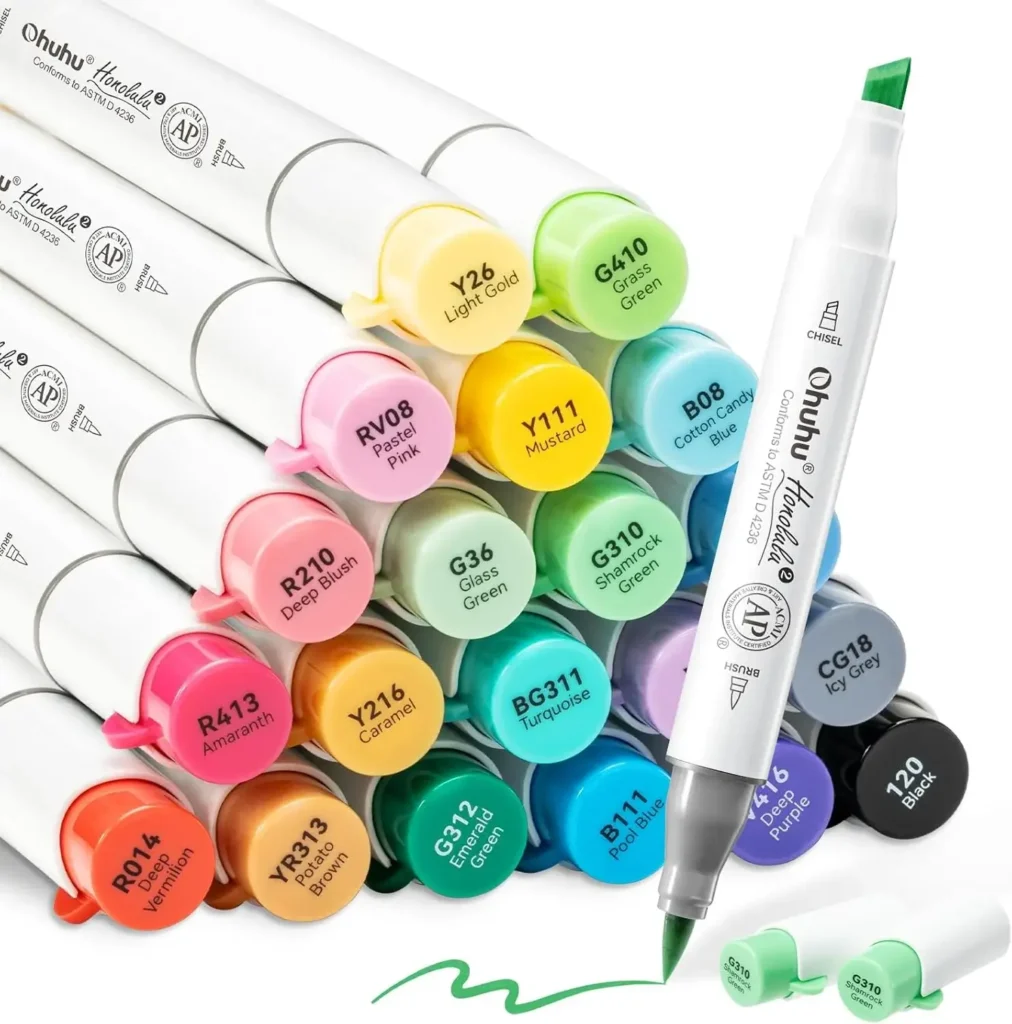
Ohuhu Honolulu is the easiest alcohol-marker recommendation for most adult colorists. The line gives you a flexible brush tip, a large color range, and good control without the cost of building a full Copic collection.
The standard Honolulu marker pairs a brush tip with a chisel tip. Honolulu B pairs the brush with a fine tip. Brush and chisel is better for backgrounds, leaves, fabric, and broad shading. Brush and fine is more useful for small mandala spaces, faces, fur, and narrow borders.
The brush tip has enough flexibility for flicked strokes and gradual shadows, yet it springs back well when you use light pressure. The alcohol ink dries quickly, so adjacent strokes can merge before hard edges form. It makes it much easier to fill a large area evenly than it would be with a narrow water-based tip.
The 320-color set offers a huge range, but most buyers do not need to start there. A smaller balanced set is easier to learn and much easier to swatch. You can add special palettes later if you find that you need more skin tones, pastels, or grays.
Bleed-through is the main drawback. On ordinary coloring book pages, assume the ink will reach the back. Use a protective sheet and avoid any page with art you want to save on the reverse. The cap color is also only a rough guide, so make a swatch chart on similar paper before starting.
Ohuhu also sells replacement brush nibs and refill ink for selected color codes. Availability can vary by color and region, so it is not as complete a refill system as Copic.
Pros
- Flexible brush tip
- Strong value for an alcohol marker
- Very large color range
- Choice of brush and chisel or brush and fine
- Replacement brush nibs available
- Refill ink available for selected colors
Cons
- Bleeds through common coloring book paper
- Cap colors should not replace a swatch chart
Best For
Single-sided adult coloring books, smooth gradients, large floral pages, backgrounds, and colorists who want a brush marker without Copic pricing.
2. Tombow Dual Brush Pens
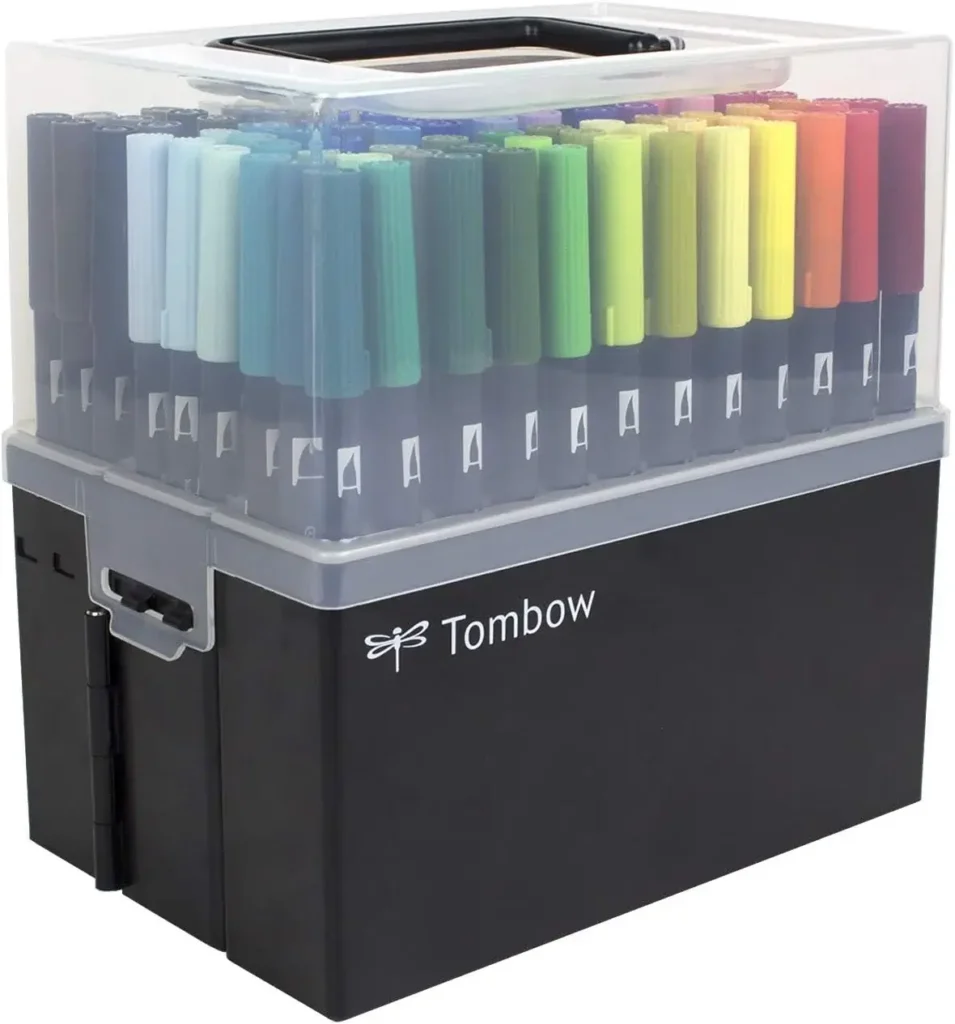
Tombow Dual Brush Pens make sense when you care more about protecting the page than getting the deepest alcohol-marker blend. They use blendable water-based ink and pair a flexible nylon brush tip with a fine tip.
The brush tip can make thin, medium, or broad strokes depending on pressure. That makes it useful for petals, leaves, hair, lettering, and medium-size areas. The fine tip gives a steady line for tiny sections and printed borders.
Tombow offers 108 options including a colorless blender. The pens are also sold individually, so you can replace a favorite shade without buying another full set. They are not filled through an ink refill bottle, and their nibs are not part of a replaceable-nib system.
For coloring books, the biggest benefit is the lower bleed risk. A normal light layer is much less likely to pass through thin paper than alcohol ink. Still, do not treat that as a promise. Dark colors, repeated passes, and damp-brush work can show through or roughen a weak page.
Blending works differently from alcohol markers. You can touch two shades together on the page, use the colorless blender, or scribble ink onto a non-porous palette and lift it with a damp brush. The palette method gives you more control over how much water reaches the paper. It is a better choice for thin pages than soaking the design directly.
The brush tip can fray if you push it across rough paper or press too hard. Smooth paper and a light hand help it keep its point.
Pros
- Lower bleed risk than alcohol markers
- Flexible brush tip and useful fine tip
- Water-based, blendable, and odorless
- Available in a broad range of colors
- Individual pens are available
- Good for soft washes and mixed-media pages
Cons
- Can streak across large flat areas
- Too much water can buckle or roughen coloring book paper
- Brush tip can wear on rough paper
Best For
Double-sided books, thin pages, botanical designs, soft watercolor-style color, and colorists who want a low-odor marker.
3. Copic Sketch Markers
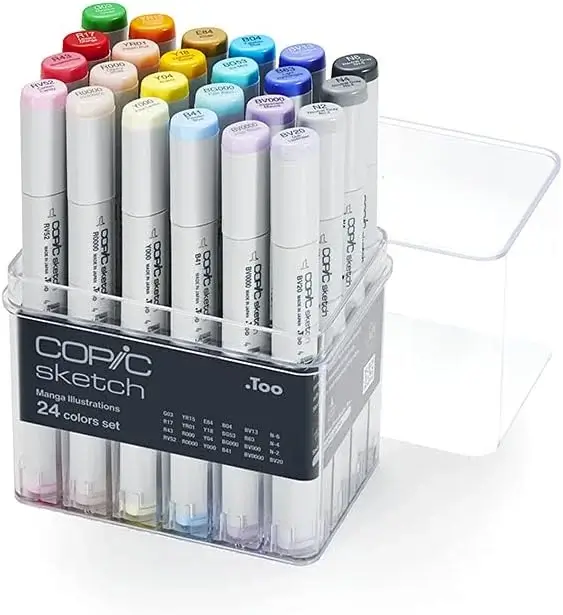
Copic Sketch is the premium choice for someone who colors often and wants a long-term marker system. Each marker has a flexible Super Brush nib and a Medium Broad nib. The line includes 358 colors, and every color has a matching refill ink.
The brush nib is the main reason people stay with Copic. It responds to small pressure changes, which helps with tapered fur, hair, folds, petals, and soft shadow edges. The broad nib covers larger areas and can also make narrower lines when turned onto its edge.
The ink blends smoothly, but Copic cannot defeat thin paper. It is still an alcohol-based dye ink, so it will commonly bleed through coloring book pages. In fact, good flow can push ink through quickly if you keep layering one spot. Use a blotter and reserve Copic for single-sided pages unless you are willing to lose the art on the back.
Refill support is the strongest part of the system. Copic says one current refill bottle can refill a Sketch marker up to seven times, and worn nibs can be replaced. That reduces waste and lets frequent users keep a chosen color set working for years.
Copic uses dye ink, and the colors may fade with strong ultraviolet exposure. Keep finished pages away from direct sunlight if color life matters.
The high starting cost is real. A small group of well-chosen blending colors makes more sense for most hobbyists than a huge set. Start with the color families you use most, then add singles as gaps become clear.
Pros
- Very responsive brush nib
- 358-color range
- Refill ink available for every color
- Replaceable nibs
- Easy to build a set one marker at a time
- Strong control for gradients and tapered strokes
Cons
- High purchase price
- Dye colors can fade under strong light
- A large collection takes time and money to build
Best For
Frequent colorists, people who want refillable markers, carefully built color families, and smooth work on single-sided or removable pages.
4. Prismacolor Premier Dual-Ended Art Markers
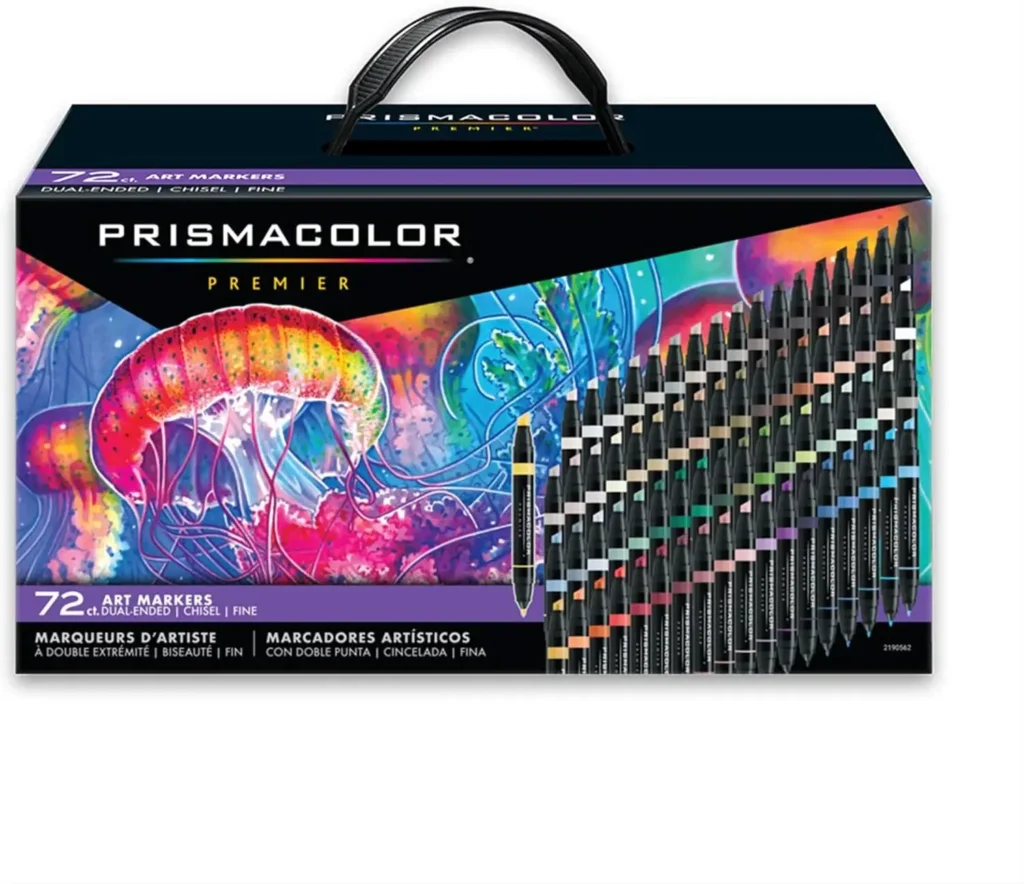
Prismacolor Premier Art Markers are a strong option for people who prefer a firm tip over a soft brush. The classic version combines a fine tip with a chisel tip, and Prismacolor palette of 200 colors. Some newer kits pair a fine tip with a brush tip, so check the exact product before buying.
The fine tip is useful in small mandala spaces, facial details, feathers, patterns, and narrow outlines. It feels more fixed than a brush nib, which can help when you want the mark to stay the same width. The chisel tip covers larger areas and can make several line widths depending on its angle.
The alcohol-based dye ink is rich and fast drying. That gives solid color quickly, but it also raises bleed risk. A single dark pass may be enough to mark the reverse side of a thin page. Work lightly, keep a blotter behind the design, and avoid repeated passes just to make the shade look darker.
These markers are not part of an ink-refill system. If a favorite color runs out, you will need a replacement marker. The firm tip design is also less forgiving for soft gradients than a good brush nib. You can blend with it, but the transition usually takes more planning and careful overlap.
Prismacolor is best when control matters more than a paintbrush feel. It is especially useful for dots, short texture marks, crisp edges, and bold sections that need one confident layer.
Pros
- Firm fine tip for small spaces
- Chisel tip covers larger shapes
- Broad 200-color palette
- Rich color with quick drying
- Good for dots, lines, and texture
Cons
- High bleed-through risk on thin paper
- Standard markers are not ink-refillable
- Firm tips are less fluid for soft brush-style blends
Best For
Detailed mandalas, geometric pages, point work, small textures, and colorists who prefer a firm nib.
5. Arteza EverBlend Art Markers
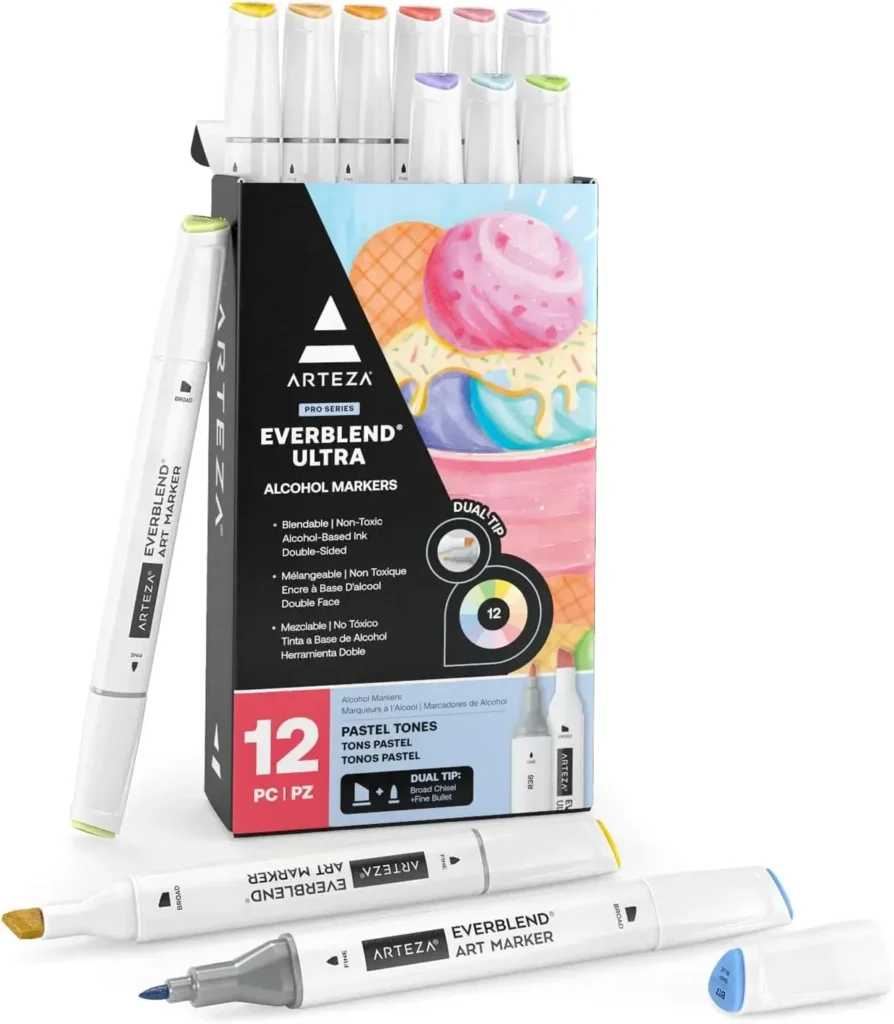
Arteza EverBlend markers are another alcohol-based option with a firm fine tip and a broad chisel tip. There are sets up to 120 colors, though set availability can vary.
The triangular barrel is comfortable to hold and less likely to roll off a table. The fine tip works for outlines and small areas, while the chisel fills blocks of color faster. This pairing suits pages with both narrow printed sections and larger backgrounds.
EverBlend ink dries quickly and can create smooth shading when adjacent strokes overlap while wet. It still behaves like alcohol ink on book paper. Expect bleed-through and place a protective sheet behind every page.
Arteza offers replacement nibs for the line, which helps when a tip wears before the ink runs out. The lack of a brush tip in the standard EverBlend set is the limit. You can shade with the fine and chisel ends, but tapered strokes and small curved blends take more effort than they do with Ohuhu Honolulu or Copic Sketch.
Pros
- Firm fine and broad chisel tips
- Triangular barrel stays in place on a table
- Sets with a wide range of colors
- Replaceable nib support
- Useful for flat fills and controlled shading
Cons
- Standard set does not have a brush tip
- Alcohol ink bleeds through thin pages
- Not ink-refillable
Best For
Geometric designs, broad blocks of color, firm line control, and buyers who prefer fine and chisel tips over a brush.
6. Bianyo Classic Series Alcohol Markers
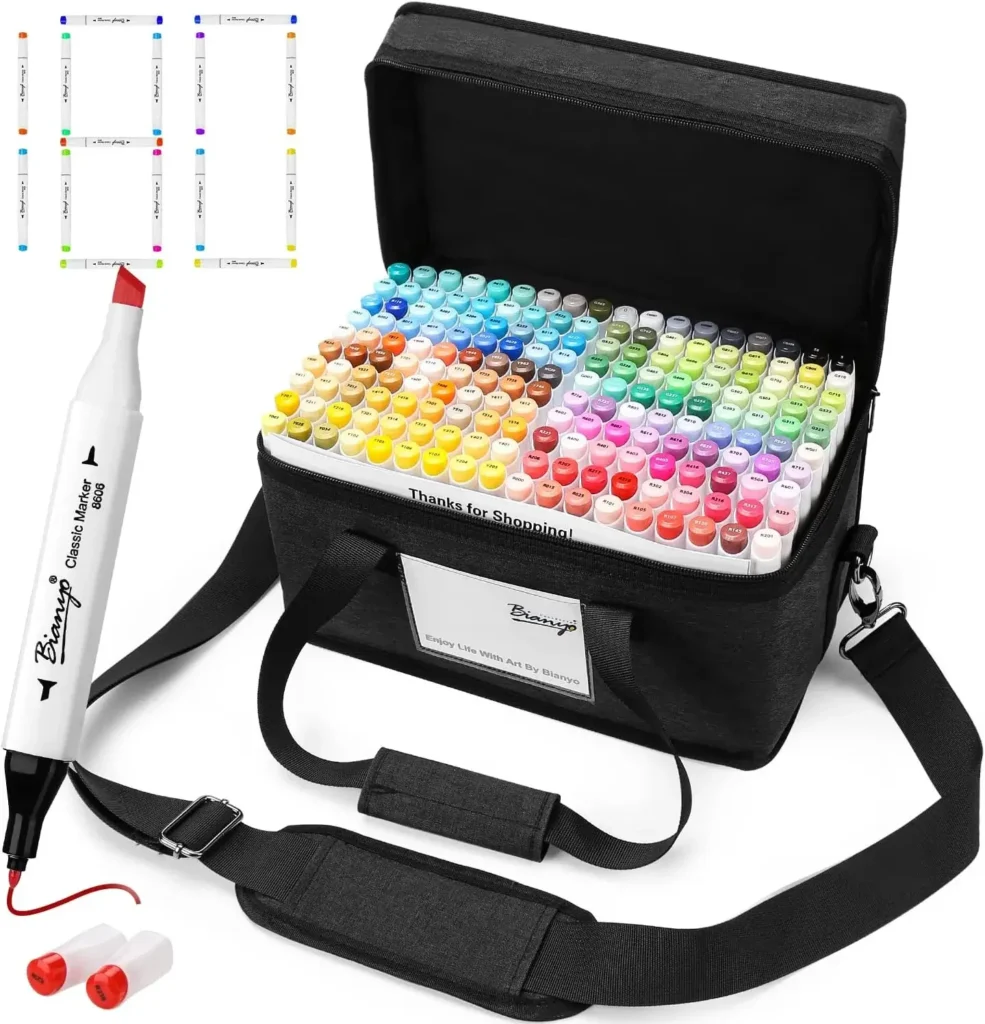
Bianyo Classic Series is for a beginner who wants many alcohol-marker colors at a low starting cost. The markers pair a broad tip with a fine tip and are sold in large sets, including 72 and 180 colors.
The broad end handles backgrounds and large shapes. The fine end is better for borders and small printed areas. Neither end has the flexible feel of a brush nib, so soft flicks and curved gradients take more work.
Bleed-through is expected. These markers use alcohol-based ink, and a low price does not change how that ink behaves on absorbent paper. Keep a blotter behind the page and use the set in single-sided books whenever possible.
The lower price also comes with a greater need to check the set when it arrives. Swatch every marker, compare the code on the cap with the result on paper, and look for weak or dry colors while the return window is still open.
Bianyo sells some individual markers, which is useful when a common shade runs out. It does not offer the same complete refill-and-nib system as Copic. It is an affordable practice set, not a marker collection you will rebuild forever.
Pros
- Low cost per marker
- Large color sets
- Broad and fine tips cover common coloring tasks
- Carrying case included with major sets
- Some individual replacement colors available
Cons
- No flexible brush tip in the Classic Series
- High bleed-through risk
- Color and ink-flow consistency can vary
Best For
Beginners trying alcohol markers, practice pages, simple flat color, and anyone who values a large palette over refill support.
7. Ohuhu Maui Water-Based Markers
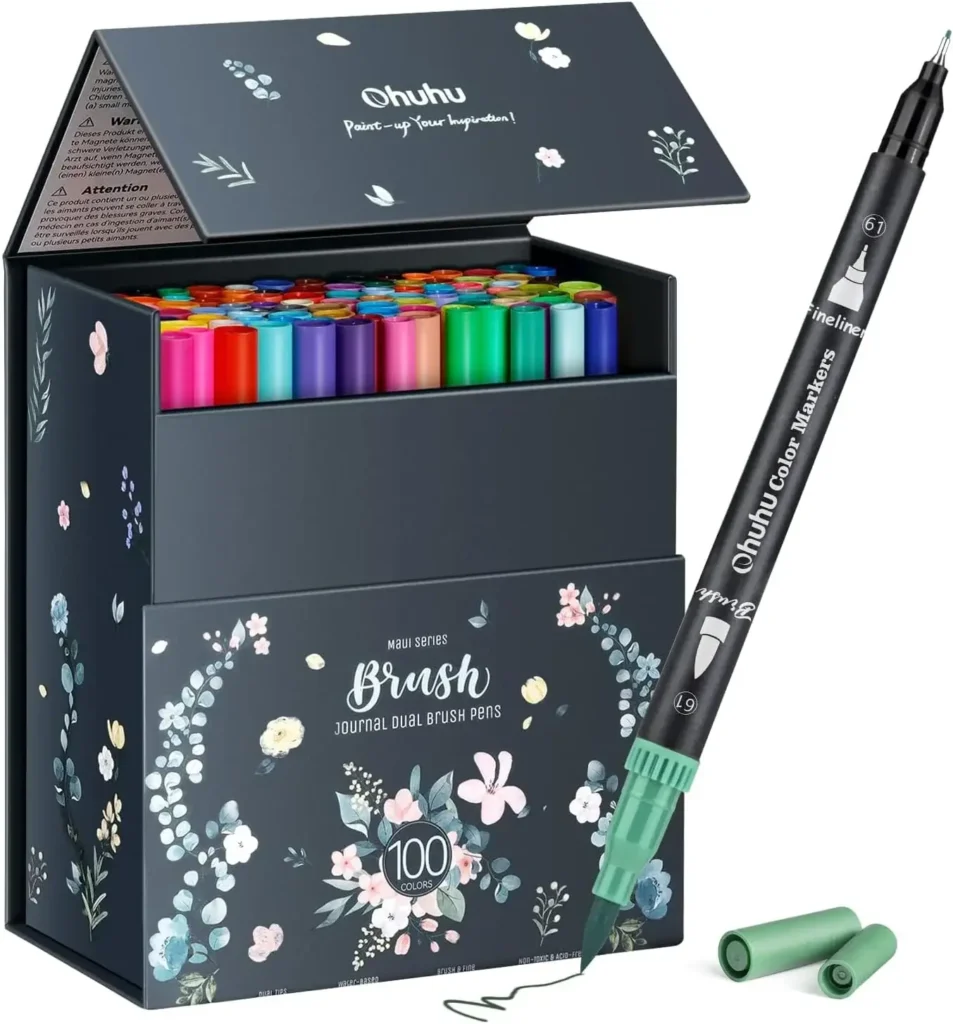
Ohuhu Maui gives beginners a large water-based color range for less than many premium brush-pen sets. Each marker has a soft brush tip and a 0.4 mm fine tip. Sets are available with up to 160 colors.
The fine tip is one of the most useful features for adult coloring books. It can reach tiny petals, eyes, lines, symbols, and corners without flooding the space. The brush end handles lettering, medium fills, and varied strokes.
Because the ink is water-based, the bleed risk is lower than it is with the alcohol sets. That makes Maui a more sensible choice for thin pages and double-sided books. Heavy layering can still show through, and too much added water can roughen the sheet, so test first and keep each pass light.
The brush is softer than a fixed bullet tip, but it may wear faster than Tombow’s nylon brush on rough paper. Keep pressure low and use the side of the brush for wider coverage instead of flattening the point.
These markers are not refillable. Large sets can also contain shades that look very close to one another. A swatch chart solves most of that confusion and helps you see the actual color before it touches the design.
Pros
- Lower bleed risk than alcohol markers
- Brush and 0.4 mm fine tips
- Large color selection
- Good value for beginners
- Useful for lettering and small details
Cons
- Too much water can damage the page surface
- Brush tips wear faster with hard pressure
- Not refillable
Best For
Beginners, thin coloring books, small details, light brushwork, and buyers who want many water-based colors on a modest budget.
How to Choose the Right Marker for Your Coloring Style
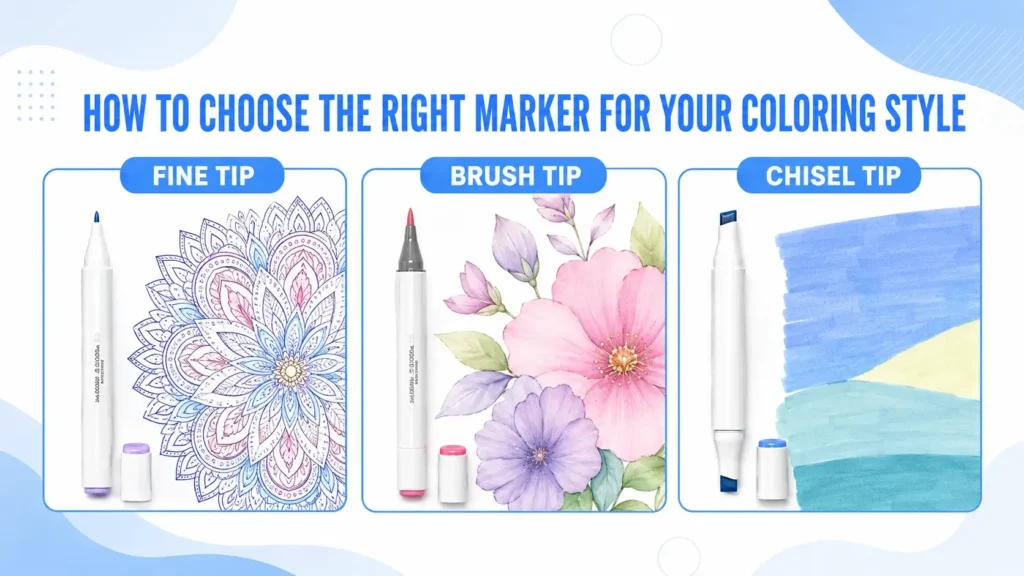
The best marker is not simply the one with the largest color count. It is the one that works with your book and the way your hand moves across the page.
1. Start With the Page, Not the Brand
Check if the book is single-sided or double-sided. This decision matters more than the logo on the marker.
- For double-sided pages, start with water-based markers and test the darkest shade.
- For single-sided pages, alcohol markers are easier to use because damage to the reverse may not matter.
- For removable pages, alcohol markers work well when you place each sheet on a hard surface with a blotter underneath.
- For art you cannot replace, test in the margin, on the title page, or on a photocopy first.
Paper weight helps, but the pound value can refer to different paper categories, so 80 lb paper is not always the same thickness or density from one product to another. GSM is easier to compare, but finish and absorbency still matter.
2. Match the Tip to the Design
Detailed Mandalas and Small Patterns
Choose a firm fine tip or a brush-and-fine marker. Prismacolor Premier, Bianyo Classic, Ohuhu Honolulu B, and Ohuhu Maui all give you a narrow end for small spaces.
Large Backgrounds and Landscapes
Choose a brush or chisel tip. Ohuhu Honolulu and Copic Sketch make it easier to overlap wet strokes without leaving hard bands. A chisel tip from Arteza, Prismacolor, or Bianyo can fill broad shapes quickly, but curved sections need more wrist control.
Soft Shading and Gradients
Alcohol brush markers are the simplest option. Ohuhu Honolulu gives the best value, while Copic Sketch gives the most complete refill system.
Watercolor-Style Effects
Choose Tombow Dual Brush Pens or Ohuhu Maui. Put ink on a palette, lift it with a lightly damp brush, and bring only a small amount of moisture to the page.
Dots, Texture, and Short Lines
A firm fine tip is better than a soft brush. Prismacolor Premier and Bianyo Classic can make repeated dots and short texture marks without changing line width as much.
3. Decide If Refills Matter
Refills matter when you use the same colors every week. Skin tones, pale grays, greens, and light blending shades often run out first.
Copic has the clearest long-term system because all 358 colors have matching refill ink and replaceable nibs. Ohuhu offers refill ink for selected colors and replacement brush tips, but you should check the exact color code and regional stock before relying on that support.
Tombow pens can be bought individually, which is useful even though the barrel itself is not refilled. Bianyo also lists some individual replacement colors. Prismacolor, Arteza, and Ohuhu Maui do not offer the same complete bottled-ink setup.
If you color only now and then, a refill system may not save enough money to justify a high starting price. A smaller mid-priced set is often the better buy.
4. Ignore the Cap Until You Swatch the Ink
Plastic cap colors are estimates. The same ink can also look different on bright white, cream, gray, smooth, or absorbent paper.
Make a swatch card with:
- Marker name or code
- One light pass
- A second layer after drying
- A small blend with a nearby shade
- A check of the reverse side
Keep the card with the set. It will save you from putting peach on a page when the cap looked coral.
Tips for Better Results and Less Bleed
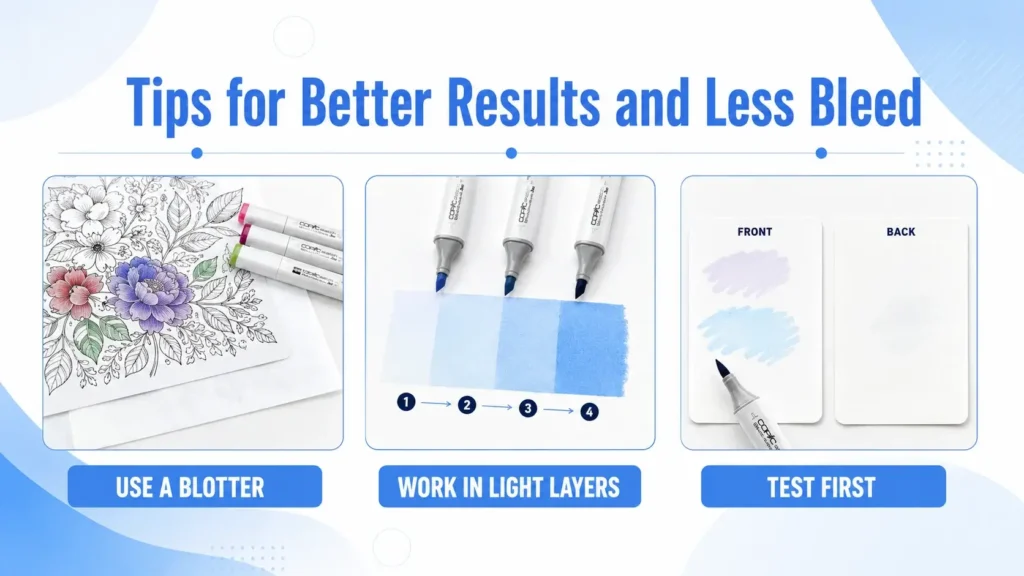
1. Always Use a Blotter Page
Place a sheet of cardstock or several sheets of scrap printer paper behind the page you are coloring. Replace the blotter when it becomes wet or heavily stained. A saturated sheet can transfer old ink back onto the next page.
A blotter protects the page below. It does not stop bleed-through on the page you are coloring. That difference is important, especially in double-sided books.
2. Test the Darkest Color First
Dark reds, purples, blues, and grays make bleed and ghosting easy to see. Test one in an unused corner. Apply the same pressure and number of layers you plan to use in the design, then wait for it to dry before checking the back.
3. Keep a Wet Edge With Alcohol Markers
Work in small sections. Place each new stroke beside the last one before the edge dries. Slight overlap helps the area look even.
For a simple two-color blend:
- Cover the shape with the lighter color.
- Add the darker color in the shadow area while the first layer is still damp.
- Use the lighter marker across the meeting point with short strokes.
- Stop before the paper becomes soaked.
More ink is not always a better blend. Once the paper is saturated, the color can spread past the printed line and into the blotter.
4. Use Less Water Than You Think
When using water-based markers as watercolor, scribble ink onto a plastic palette, ceramic plate, or other non-porous surface. Pick up a small amount with a damp brush.
The brush should be moist, not dripping. Too much water can buckle the paper, soften printed lines, and cause the surface to pill.
5. Treat the Colorless Blender as an Ink Mover
An alcohol colorless blender does not work like a pale blending color. It pushes and dilutes dye. It can soften a small edge, lighten a spot, make texture, or move a minor mistake. It can also spread ink farther if you use too much.
Test it on scrap paper before trying to correct the final page.
6. Add White Highlights Only After the Page Dries
A white gel pen can add eye shine, water drops, stars, fur strands, and small reflective points. Wait until the marker layer is fully dry. A wet marker layer can stain the gel tip and turn a clean white mark into a muddy one.
7. Store Dual-Ended Markers Flat
Horizontal storage helps keep both ends supplied with ink. Close every cap until it is secure, and keep alcohol markers away from heat, flames, and direct sunlight. Use alcohol markers in a room with good airflow.
Follow the maker’s directions when they differ. Do not pour random alcohol or blending fluid into a dry marker. Use the matching refill ink when one is available.
8. Test Printed Lines Too
Marker ink can react with some printed outlines. Alcohol ink may soften or smear certain inkjet lines, while other printing methods stay clean. Test a small printed section before coloring across important facial features or very fine line art.
Frequently Asked Questions
What are the best markers for adult coloring books?
Ohuhu Honolulu is the best overall alcohol marker for value, color range, and brush control. Tombow Dual Brush Pens are better for thin or double-sided pages because their water-based ink has a lower bleed risk. Copic Sketch is the best premium option for buyers who want matching refill ink and replaceable nibs.
Can I use alcohol markers in any coloring book?
You can use them, but expect bleed-through on normal coloring book paper. Use alcohol markers in single-sided books or on removable pages, and always place a blotter behind the sheet. Do not use them over reverse-side art you want to keep.
Which markers do not bleed through paper?
No marker can be promised not to bleed on every paper. Water-based markers usually have a lower bleed risk than alcohol markers, but a heavy layer can still show through a thin or absorbent page. Test the exact marker and book together.
How do I stop markers from bleeding onto the next page?
Place cardstock or several sheets of scrap paper behind the page. Replace the protective sheet once it becomes wet. It saves the next page, though it cannot keep ink from reaching the back of the current sheet.
Brush tip, chisel tip, or fine tip: which is best?
A brush tip is best for blends, tapered strokes, petals, and hair. A chisel tip fills large areas quickly. A fine tip is best for tiny spaces, borders, dots, and narrow patterns. For most adult coloring books, brush and fine is the most useful dual-tip pairing.
Can I blend water-based markers?
Yes. You can use a colorless blender, touch nearby colors while they are damp, or move ink from a palette with a damp brush. Use little water on standard coloring book paper to reduce buckling and surface damage.
How long do art markers last?
There is no reliable universal lifespan. A marker used for full backgrounds will empty much faster than one used for small details. Cap seal, storage, paper absorbency, and favorite-color use all matter. Refillable markers can stay in service much longer because the ink and nibs can be replaced.
Final Verdict
The best markers for adult coloring books depend first on the page you are trying to protect.
Ohuhu Honolulu is the best overall alcohol marker for most buyers. It has a useful brush tip, a wide color range, and a price that makes it easier to build a full palette. Just use it on single-sided pages and keep a blotter underneath.
Tombow Dual Brush Pens are the better choice for thin and double-sided books. Their water-based ink lowers bleed risk, while the brush and fine tips cover most adult coloring tasks.
Copic Sketch is the premium pick for frequent colorists. Its 358-color refill system and replaceable nibs make it the strongest long-term option, but it still bleeds through common coloring book paper.
Choose Prismacolor Premier for firm fine details, Arteza EverBlend for controlled fine-and-chisel work, Bianyo for a low-cost alcohol set, and Ohuhu Maui for an affordable water-based palette.
Whichever set you choose, make a swatch chart and test the back of the page first. That small check tells you more than any bleed-free claim on a product page.
Disclosure: This post contains affiliate links. As an Amazon Associate, I earn from qualifying purchases. It means that if you click on an Amazon link on this site and make a purchase, I may earn a small commission at no extra cost to you. Thank you for your support!